 Scottsdale Pool Acid Wash
Pool Acid Wash in Scottsdale
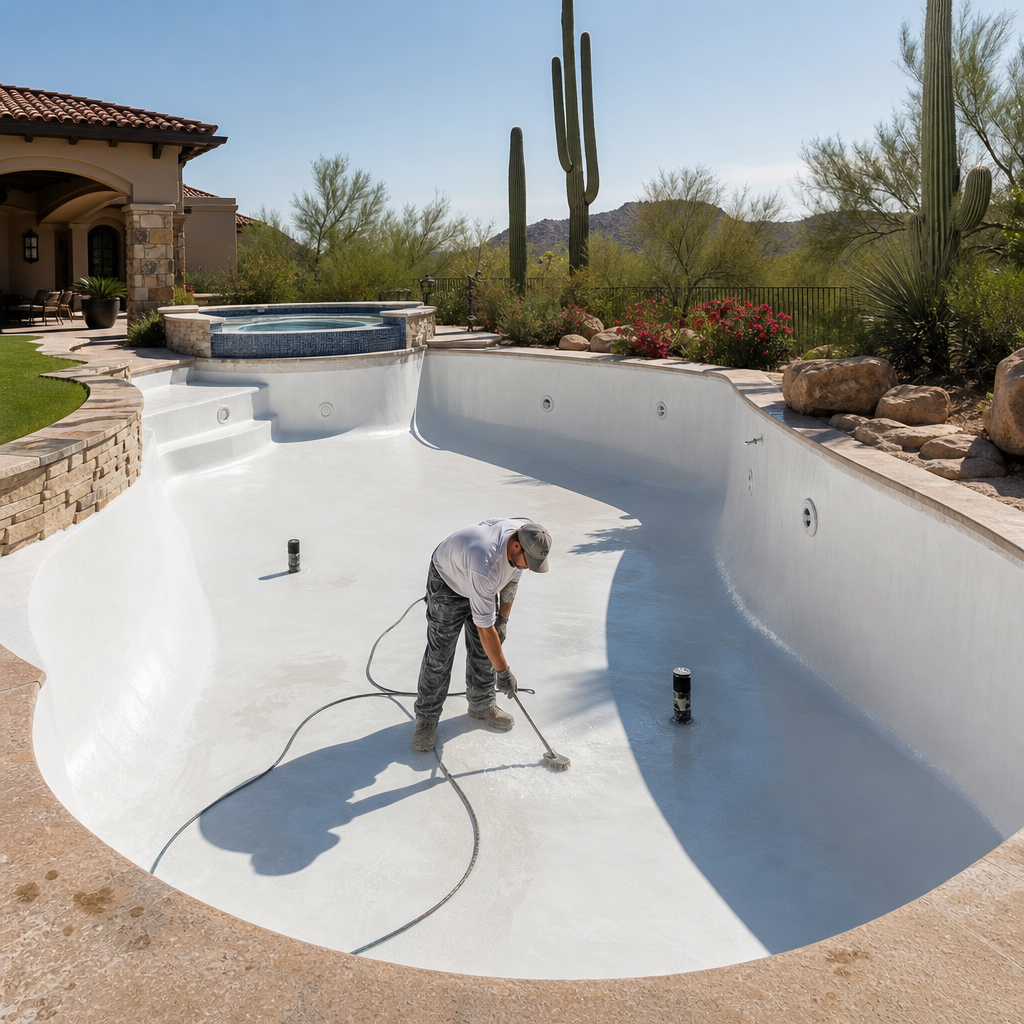
A pool acid wash is a full restoration: the pool is drained, the bare plaster or pebble is washed with a controlled muriatic acid solution to strip stains, calcium, and algae, plus a paper-thin layer of the old plaster itself, then it is neutralized, given a chlorine bath, and refilled. The result is a bright, fresh surface that brushing and chemicals could never recover. For most Scottsdale pools it runs $400–$800; larger luxury pools in Scottsdale and Paradise Valley run $700–$1,200 or more.
This is our flagship service. If your plaster is gray, chalky, stained, or blotchy and you’re tired of looking at it, this is the fix.
When your pool needs an acid wash
Not every dingy pool needs a full acid wash, but these are the signs it does:
- Dull, chalky, or gray plaster that no longer brightens no matter how much you brush and shock it.
- Stubborn stains: rusty iron and copper metal stains, brown organic tannin stains, or yellow-green mottling from years of sunscreen and oils.
- A pool that went green and, once cleared, reveals stained or scaled plaster underneath. Often the green cleanup and acid wash happen in the same visit.
- Heavy calcium across the plaster (not just the tile). Waterline-only calcium can sometimes be handled with tile cleaning or bead blasting without draining.
- Prepping to resurface: old plaster gets acid-etched so a new coat bonds. That’s a specific process covered under resurfacing prep.
Why Scottsdale pools stain and scale so fast
Scottsdale sits on some of the hardest municipal water in the country: roughly 13 to 19 grains per gallon of hardness (about 215 to 320 mg/L as calcium carbonate in Scottsdale Water’s published report), with a pH that runs up to about 8.3. High pH and high calcium push mineral out of solution and onto your plaster and tile. Add relentless UV, year-round swimming, and evaporation that concentrates minerals even further, and Scottsdale plaster ages faster than plaster almost anywhere else. That’s why the 3–5 year acid wash cycle that’s “occasional maintenance” elsewhere is closer to a regular event here.
The luxury factor matters too. Scottsdale and Paradise Valley are full of large-format pools: negative edges, big Pebble Tec spas, custom plaster on estate lots. More surface means more area to stain, more waterline tile to scale, and a premium finish that has to be treated with care. A rushed acid wash on a pebble finish can leave it dull and uneven. Ours don’t, because we know the difference between blasting a 1970s plaster pool and gently etching a high-end pebble surface.
The acid wash process, step by step
It should be done the careful way, because acid on a pool surface is unforgiving if you rush it.
- Photo quote first. You send photos of the pool, waterline, and worst staining. We send a flat price, with no sales visit needed for most jobs.
- Drain, done legally and slowly. The pool drains to your property’s sewer clean-out at a controlled rate (Scottsdale asks for a slow flow, under 12 gallons a minute, so the sanitary sewer doesn’t back up) or onto your landscaping if the water chemistry is safe for plants. It should never drain to the street, alley, storm drain, or a neighbor’s lot. On big estate pools this is a monitored, multi-hour process.
- Work in sections, keep it wet. Once the pool is empty the plaster is wetted and worked top to bottom in sections, never letting the surface dry out, dried plaster etches unevenly and leaves streaks. The wash should be timed for the cooler part of the day.
- Apply, scrub, rinse. A measured acid-and-water solution goes on the wetted plaster, the stains and scale are scrubbed loose, then rinsed immediately so the acid doesn’t keep eating.
- Neutralize the waste. The acidic runoff is neutralized with soda ash and pumped out responsibly, not left to corrode your equipment or run off-property.
- Chlorine bath. A strong chlorine bath kills off any remaining algae spores and organics so the pool doesn’t re-green.
- Refill and rebalance. The pool is refilled and the chemistry dialed (pH, alkalinity, calcium hardness, and chlorine) so you can swim, not fight a cloudy pool for a week.
The honest part: acid washing has a limit
Here’s what a lot of companies won’t put in writing. Every acid wash removes a thin layer of plaster. That’s the whole mechanism. You’re taking off the stained top skin to reveal clean surface beneath. Do it every few years and a plaster surface lasts a good long time. Do it too often, or acid wash a surface that’s already thin, and you burn through the plaster and end up needing a resurface sooner.
So before anyone quotes a wash, they should look at whether your surface can take one. If the plaster is thin, deeply mottled, or already showing exposed aggregate (a rough, pebbly gray patchwork where the smooth finish used to be), a wash is a waste of money and resurfacing prep is the better path. A pro who tells you that gives up a job today and earns your trust for the bigger one.
The surface decides the method: plaster, quartz, pebble, fiberglass
Scottsdale has every finish type in the book, and the acid pass changes with each one. Classic white plaster, what most of the city’s older pools south of Shea still wear, is the textbook case: a standard wash strips the stained skin and the brightening is dramatic. Quartz aggregate finishes wash much the same way, with a little more margin for error because quartz stands up to acid better than plain marcite. Pebble is Scottsdale’s signature surface, and it wants a lighter, section-by-section pass: done that way, a wash brings back the color and texture that hard water has grayed out, which is why so many of Scottsdale’s remodel-era pebble pools eventually get one. Fiberglass plays by different rules entirely: acid has no business on a gelcoat. There’s no plaster layer underneath to reveal, so acid only degrades the gel. A stained fiberglass shell gets a gentler cleaning and polish instead. Mention your finish when you send photos, or just send them; the surface usually identifies itself, and the quote should be for the method that fits it rather than a one-size wash.
Chlorine wash vs. acid wash: a quick note
You may hear about a “chlorine wash” as an alternative. It’s a gentler option that uses strong chlorine rather than acid to lift organic staining and algae from the plaster without removing a plaster layer. It’s the right tool for a pool that’s mainly discolored by algae and organics but whose plaster is otherwise sound, and because it doesn’t strip plaster, it doesn’t count against your surface’s finite acid-wash life. What a chlorine wash won’t do is remove hard-water calcium scale or deep metal staining; that’s where a true acid wash earns its keep. When you send photos, part of what gets decided is whether your pool actually needs the acid or whether a lighter chlorine wash gets you there without spending plaster. Choosing the gentler option when it fits keeps your surface alive longer.
Pricing
| Pool | Typical acid wash cost |
|---|---|
| Standard residential (10,000–20,000 gal) | $400–$800 |
| Large / luxury (Scottsdale, Paradise Valley estates) | $700–$1,200+ |
| Heavy staining or post-green-pool | Top of range |
Every quote is flat and up-front. The refill water is on your city meter (a typical pool is 10,000–25,000 gallons, estate pools much more) so ask for the rough gallons and it’s no surprise. See the full pricing page.
Get your plaster bright again
Serving Scottsdale, Paradise Valley, Fountain Hills, Tempe, and Cave Creek. Send photos for a fast, flat quote and find out what your pool needs, even if that’s not an acid wash.
Frequently Asked Questions
How much does a pool acid wash cost in Scottsdale?
Standard residential pools run $400–$800. Larger and luxury Scottsdale and Paradise Valley pools with big plaster or pebble surfaces, or heavy staining, run $700–$1,200 or more. Pool size and stain severity are the two drivers.
How often can I acid wash the same pool?
Every 3–5 years is typical, but a plaster surface can only take a handful of washes over its life since each one removes a thin layer. Once the plaster is thin or mottled, resurfacing is the better call than another wash.
How long until I can swim again?
Usually 2–4 days from empty to swimmable. The acid wash itself is about a day; the rest is drain time and refilling 10,000–25,000+ gallons, then rebalancing the chemistry.
Will an acid wash hurt my Pebble Tec finish?
Not when done by a crew that knows pebble. Premium finishes need a lighter, more careful acid touch than standard plaster. Pebble is common in Scottsdale and Paradise Valley, so ask any crew, us included, how it treats that surface.
Do you drain the water legally?
Yes. The pool drains to your property's sewer clean-out at a safe rate or onto your landscaping per City of Scottsdale rules, never to the street, alley, or storm drain.
Can a fiberglass pool be acid washed?
No, and be wary of anyone who says yes. Fiberglass has a gelcoat rather than plaster, so there's no fresh layer for acid to reveal; acid just degrades the gel. A stained or chalky fiberglass shell gets a gentler cleaning and polishing approach. Plaster, quartz, and pebble are the surfaces that acid wash well.