 Scottsdale Pool Acid Wash
 Calcium & Scale Removal in Scottsdale
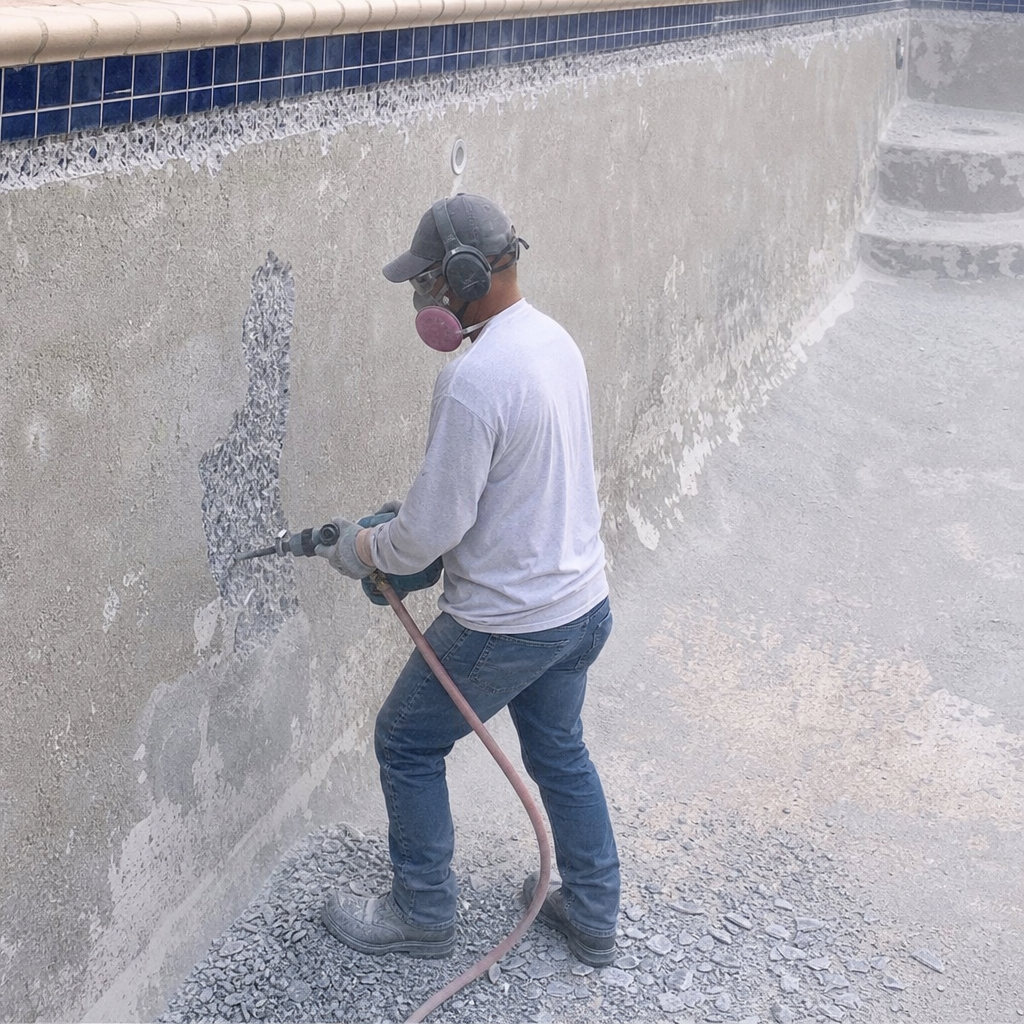
Calcium and scale removal strips the hard white crust that Scottsdale’s water leaves on your tile and plaster. For heavy buildup the tool is bead blasting, fine glass or salt media fired at low pressure to knock the calcium off without acid or damage. For lighter scale it’s targeted acid treatment. Most jobs run $200–$500, and the pool usually doesn’t need to be drained. It’s the fix when your waterline looks permanently white and no brush touches it.
Why Scottsdale has a calcium problem
This isn’t a maintenance-failure thing. It’s the water. Scottsdale’s own water reports list roughly 13 to 19 grains per gallon of hardness (about 215 to 320 mg/L as calcium carbonate) with a pH that runs up to about 8.3. Chemically, that means calcium is constantly trying to fall out of solution and cement itself onto the nearest surface. The waterline gets it worst, because that’s where evaporation concentrates minerals and deposits them in a hard band.
The result shows up as:
- A chalky white or gray crust along the waterline tile, the single most common cosmetic complaint on any Valley pool over five years old.
- Rough, scaly buildup on glass, stone, and pebble water features, spillways, and negative edges, very common on the high-end pools in Scottsdale and Paradise Valley.
- A gritty film across the plaster itself that dulls the whole pool.
You can’t chemical your way out of established calcium. Once it’s cemented on, it has to be physically or chemically removed.
Bead blasting vs. acid treatment: how to choose
The two methods aren’t interchangeable; the right one depends on how thick the calcium is and what it’s sitting on.
Bead blasting shoots a soft abrasive media (fine glass beads or salt) at the tile with a low-pressure stream. It mechanically chips the calcium off without acid and without pitting the tile when done at the right pressure. It’s the go-to for:
- Thick, crusty waterline calcium that’s been building for years.
- Glass and stone tile where you want the original surface back, not a dulled one.
- Pebble and rock features with heavy scale.
Heavy bead blasting is often priced by the linear foot of waterline tile, which is why a compact backyard pool costs less than a long-perimeter estate pool.
Acid treatment dissolves the scale chemically. It’s the right tool for lighter, thinner calcium and for plaster surfaces where a full acid wash is being done anyway. It’s gentler on the wallet for light buildup but won’t touch a thick crust the way blasting does.
If the calcium is bad enough that it’s paired with dull, stained plaster across the whole pool, the smarter move is often a full pool acid wash rather than spot calcium work; ask which makes sense for yours.
Two kinds of calcium (and why it matters)
Not all calcium buildup is the same, and the type changes how it’s treated:
- Calcium carbonate is the common white, chalky, flaky scale most Scottsdale pools get. It responds to both acid and bead blasting. It’s the everyday hard-water crust.
- Calcium silicate is a harder, grayer, more stubborn deposit that builds slowly over years and doesn’t dissolve in acid the way carbonate does. On older pools with long-neglected waterlines, this is what you’re often fighting, and bead blasting is really the only effective removal, no amount of acid will touch it.
Part of what you’re paying a good crew for is telling these apart on sight and not wasting your money running acid at a silicate deposit that will never dissolve. A good quote from photos already reads which type you’ve got.
How the job goes
- Photo quote. Send close-ups of the waterline band and any scaled features. We estimate the linear footage and quote flat.
- Protect the pool. For bead blasting, the setup should keep media and debris contained and cleaned up, not left in your pool or landscaping.
- Blast or treat. The tile is worked at controlled pressure (or lighter scale gets acid), checked along the way so the finish underneath comes back clean and undamaged.
- Clean up and rebalance. Debris cleared, the pool vacuumed as needed, and the chemistry checked.
Keeping calcium from coming back
Removal cleans what’s there, but with Scottsdale water, calcium will slowly rebuild. You can dramatically slow it:
- Keep pH between 7.2 and 7.6 and alkalinity 80–120 ppm so calcium stays in solution instead of plating out.
- Keep calcium hardness in the 200–400 ppm range for your surface.
- Brush the waterline regularly and don’t let the pool level evaporate down and leave a fresh scale ring each time.
- Plan on periodic tile cleaning: in this water, it’s normal maintenance, not a failure.
Pricing
| Job | Typical cost |
|---|---|
| Light scale, acid treatment | $200–$350 |
| Heavy waterline bead blasting | $300–$500 (often per linear foot) |
| Whole-pool calcium + dull plaster | Consider a full acid wash |
See the pricing page for the full breakdown.
Why this matters more on luxury pools
On a standard backyard pool, calcium is a cosmetic annoyance. On the high-end pools common in Scottsdale and Paradise Valley, it’s a bigger deal, because those pools are built to be looked at. Glass mosaic tile, natural-stone spillways, boulder water features, and negative edges are exactly the surfaces where a white calcium crust is most visible and most expensive-looking when it’s neglected. They’re also the surfaces most easily damaged by the wrong removal method, which is why bead blasting at controlled pressure, not scraping or harsh chemicals, is the standard for premium finishes. Protecting a five- or six-figure water feature is worth doing right the first time. If the scale has gone so far that the plaster is dull across the whole pool too, a full acid wash makes more sense than piecemeal descaling.
Get your tile line clean again
We handle calcium and scale across Scottsdale, Paradise Valley, Fountain Hills, Tempe, and Cave Creek, where well water makes calcium even worse. Send photos of your waterline for a fast quote.
Frequently Asked Questions
How much does calcium removal cost in Scottsdale?
Most calcium and scale jobs run $200–$500. Bead blasting for heavy waterline buildup is often priced by the linear foot of tile, so a small pool costs less than a large estate pool with a long waterline. Send photos of the tile band for a quote.
What's the difference between bead blasting and acid treatment?
Bead blasting shoots fine glass or salt media at low pressure to knock off heavy, crusty calcium without acid, best for thick buildup on tile. Acid treatment dissolves lighter scale chemically. The method depends on how thick the calcium is and what surface it's on.
Will removal damage my tile or pebble?
Not when done right. Bead blasting uses a soft abrasive at controlled pressure specifically so it lifts calcium without pitting glass, stone, or pebble. Aggressive DIY scraping or the wrong media is what damages tile. Ask whoever does it what media and pressure they plan to use.
Why does calcium keep coming back?
Because Scottsdale's water is genuinely that hard, roughly 13 to 19 grains per gallon. Removal cleans what's there, but calcium will slowly rebuild. Keeping pH at 7.2–7.6 and calcium hardness in range slows it a lot, and periodic tile cleaning keeps it in check.